Why Can’t You Hear Sound in Space? The Physics of Sound Transmission
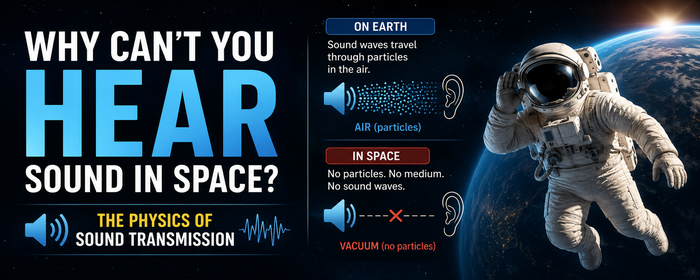
Did you know that astronauts could set off a small explosion right next to their spacecraft and hear absolutely nothing, not even a faint pop? It sounds unbelievable, but it is one of the cleanest demonstrations of physics in action. In case you are wondering why you can’t hear sound in space, the short answer is this: sound cannot travel in space because it’s a mechanical wave that needs particles to bump into each other, and space is almost completely empty. Untangling this exact kind of “why” behind an answer is what a good Physics tuition is all about. The right tutors teach students one question at a time, until the concept finally clicks, and that’s what we are here to do!
What is the Basic Principle Behind Sound Transmission?
Unlike light, sound cannot travel on its own through an empty space. The mechanical wave of sound needs a medium, such as air, water, or metal, to move through.
For example, when you clap your hands, you aren’t sending out some invisible signal; rather, you are compressing and decompressing the air molecules around you, and that chain reaction of bumping molecules eventually reaches someone’s eardrum. Take away the molecules, and there is nothing left to bump.
How Do Astronauts Talk in Space?
Astronauts talk in space via radio waves, not sound waves. Radio is an electromagnetic wave, which is part of the same family as visible light, and it doesn’t need any medium to travel. That’s exactly how mission control communicates with astronauts across millions of kilometers, even though a shout right outside the airlock would never be heard.
Interesting Fact: The sound in space is called cosmic noise, which is basically a type of electromagnetic radiation or light lying within the RF range of the electromagnetic spectrum. Sounds fun, right?
The Vacuum Problem
Space is not a ‘perfect’ vacuum, but it is close enough to be called one. Beyond Earth’s atmosphere, there are only about five particles in a volume the size of a sugar cube, as compared with air, which is roughly ten billion billion times denser, as stated by The Conversation. With a few particles floating around, there simply isn’t enough material for a pressure wave to form and travel, and that’s exactly why you cannot hear anything in space.
Note: The denser and more tightly packed the particles are, the faster sound moves, as a tutor in H2 physics tuition in Singapore might also teach you, but space simply has nothing to offer.
Why This Question Keeps Coming Up in Exams?
Wave behaviours, mediums, and vacuum-related questions appear across the syllabus, and they connect directly to topics discussed in our post on everyday Physics concepts. Whether a student is building foundations through Sec 3 physics tuition, these concept-based questions reward students who understand the why, not just the formula.
Especially for those who are struggling to connect concepts like this one to their actual exam papers, our structured A-level physics tuition classes can help, along with O-level and IP tracks.
Ready to finally make Physics work for you? Reach out to our team at Best Physics Tuition™ today and turn confusing concepts into confident exam answers.