Conservation Laws Every Physics Student Should Know

Physics Conservation Laws

Have you ever solved a physics problem correctly, but at the end, you had no idea why the answer made sense? You might think that ultimately, I reached the right answer, so why should the route bother me, but not knowing why your answer is correct is also a reason why your physics scores are dipping below the horizon. This

Read more

How to Choose the Right Equation of Motion Every Time

Equation of Motion

Every student in Singapore might have faced the dilemma where they stared at a kinematics question for longer than they should just to figure out which equation they should use. If you too are going through this, you’re not alone. Most students don’t lose marks because they can’t solve equations; they lose marks because they choose the wrong equation for

Read more

The 80/20 Rule for Scoring Better in Physics

Physics Success 80/20 Rule

When students think about studying physics, they start by spending hours staring at complex equations, filling notebooks with derivations, yet their physics scores refuse to budge. It’s truly frustrating and exhausting, and at the end of the day, if you are a student, this makes you wonder if you aren’t just wired for the subject. But, what if we told

Read more

From Equations to Intuition: Developing Physics Instincts

From Equations to Intuition

You finish a chapter, memorise formulas, solve ten practice problems, and feel confident. However, when the exam arrives, the question looks different. Panic sets in, and you are left confused about which formulas apply here. If this sounds like you, you aren’t alone because many students treat physics like a collection of equations instead of a way of thinking, but

Read more

Why Friction Problems Are Rarely About Friction Alone

Friction Problems

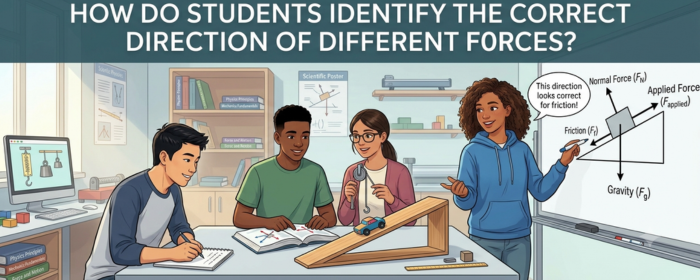
Before we talk about friction, let’s start with a classic physics textbook problem: a heavy wooden crate sitting stubbornly on a rough, inclined ramp. The question asks you to calculate the minimum force needed to push it upward, so you immediately reach for your go-to formula, Ff= µFn where Ff is the frictional force, µ is the coefficient of friction,

Read more

The Physics of Constraints: Why Objects Move Together

Physics of Constraints

You push a box across the floor, and that’s easy enough, but when you tie two boxes together with a rope and push one, suddenly you see that both the boxes are moving. Or when you think about train compartments, elevators with pulleys, or two people carrying a couch upstairs, you would notice how objects behave like one system instead

Read more

Why Most Students Misunderstand Work, Energy, and Power

Students Misunderstand Work, Energy, and Power

While studying Work, Energy, and Power, what many students do is memorise formulas, solve practice sheets, and still feel confused when concepts show up in slightly different forms. The problem here isn’t intelligence or effort; it’s that these topics are often understood as equations first, then as ideas. However, things need to be different because students need to understand the

Read more

Waves and Optics Made Easy: How Light Shapes Our World

Waves and Optics

You are staring at the Waves and Optics chapter. Something feels off already. Can you explain why light slows down in glass, not just quote the formula? And if an exam asked you to trace a ray through a prism from scratch, with no diagram given, would you know where to begin? These are the exact knowledge gaps that make

Read more

The Physics Behind GPS: How Einstein Helps You Navigate

Physics Behind GPS

We have all been late to something important or have simply lost our minds when our map on the screen starts “Recalculating…” However, do you know Einstein’s role behind GPS and the maps we use today? The answer to location facilities offered by smartphones isn’t just satellites or smart software; surprisingly, every time we use GPS, we are relying on

Read more
1 2 3 5