How to Reverse Engineer Physics Problems?
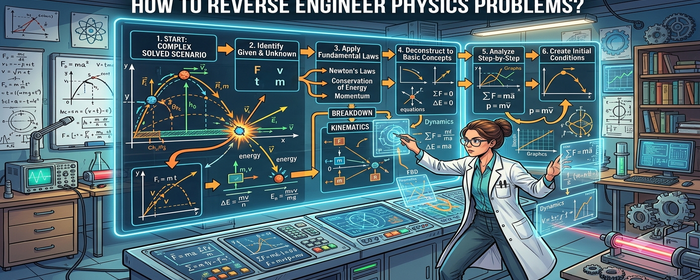
Physics as a subject explains everything in the universe and everything that’s going on around us, but most students dread their Physics exams because they generally take the wrong route to solving problems. For instance, have you ever looked at the answer to a physics question and wondered, “How was I supposed to think of that?” If the answer is yes, you are solving problems the hard way. The top-performing students in a physics tuition don’t attack numericals or questions, for that matter, from the beginning; they rather tackle them backwards, and it works phenomenally. This technique is called reverse engineering, and it can do a commendable job in helping students uncover the logic behind a solution instead of depending on crude trial-and-error.
Wondering how to master this technique, so even the toughest problems start feeling manageable? Here you go!
What Does Reverse Engineering Mean?
Literally speaking, reverse engineering is the process of starting with the final quantity or unit that you need to find and trace your way back to the information in the given question. Thus, as per the tutors of H2 physics tuition in Singapore, when you use reverse engineering, instead of asking, “Which formula should I use first?” you ask yourself, “What information do I need to calculate the final answer?”
While this looks like a simple shift in thinking; it turns confusing questions into a series of logical steps. To further clarify things on reverse engineering problems, here’s a table that you can consider:
| Step | What You Do | How It Helps? |
| Identify the target | Write down what you need to find | Keeps you focused |
| Find the required formula | See which variables are needed | Creates a roadmap |
| Match with given values | Identify missing quantities | Reveals intermediate steps |
| Solve backwards | Work toward the known information | Reduces guesswork |
Why This Strategy Works?
Physics is built on connected concepts, so even when you miss one equation, it provides the missing value required for another step or equation in the problem.
When you work backwards, you naturally identify these connections instead of memorising long solution methods, and this makes the task easy, which is why it’s even preferred by many tutors at A-level physics tuition.
Common Mistakes to Avoid
Reverse engineering works best when you avoid these common errors:
- Jumping into calculations without identifying the final goal.
- Ignoring units while connecting equations.
- Using formulas before checking whether their conditions are satisfied.
- Skipping diagrams for motion or force-based problems.
Taking just one extra minute to plan often saves several minutes of confusion later, so plan ahead and when in doubt, don’t forget to seek help with expert tutors at a reliable sec-3 physics tuition.
Practice the Process, Not Just the Answer
Every solved question is an opportunity to learn more than the final answer. After completing a problem, go back and ask yourself, “Could I have predicted this solution by working backwards?” Over time, you will start recognising patterns that repeat across mechanics, electricity, waves, and modern physics.
Conclusion
The best physics students aren’t necessarily the fastest calculator; they are the smartest planners. Reverse engineering trains your brain to think logically, connect concepts, and solve unfamiliar questions with confidence. Build this habit today, and you’ll spend less time guessing and more time scoring.
Ready to solve physics problems like a topper? Join Best Physics Tuition™ and learn proven problem-solving techniques, concept-based learning, and expert strategies that help you excel in every exam.