Why Does Symmetry Matter in Physics?
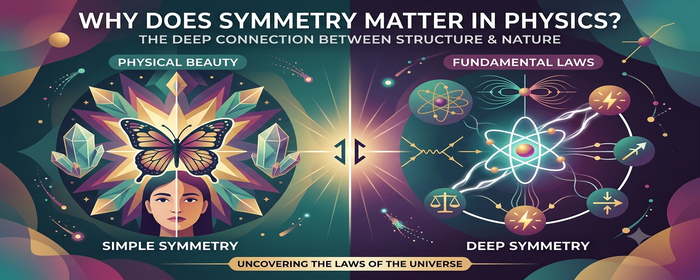
Why does symmetry matter in Physics? Because it reveals the hidden patterns that govern natural laws and helps to predict how the universe behaves.
Have you ever solved a Physics problem correctly, but wondered why the same equations seem to work repeatedly in different situations? Well, many students focus only on the formulas without understanding the deeper principles connecting them. And one of those powerful principles is symmetry, which is far more than visual balance.
In Physics, symmetry explains why certain quantities remain constant, why the laws of conservation exist, and why the universe behaves predictably. Once you understand symmetry comprehensively with a little help from reliable physics tutors in Singapore, many complex concepts can suddenly become easier to grasp. Still wondering why you should master symmetry while studying physics? Here you go!
But First, What Does Symmetry Mean in Physics?
In everyday life, symmetry usually refers to balanced shapes, but in Physics, it means something much deeper. A system is symmetrical if it remains unchanged after a specific transformation, such as shifting its position, rotating it, or moving forward in time.
For instance, if you do a physics experiment today in London, and repeat it next week in Tokyo, the fundamental laws of nature do not change at all, and this spatial and temporal invariance proves that nature plays by consistent, predictable rules everywhere and at all times throughout cosmic history.
How Does Symmetry Create the Laws of Conservation?
In 1915, a brilliant mathematician, Emmy Noether, proposed one of the most solid breakthroughs in theoretical physics, known as Noether’s Theorem. She proved mathematically that every continuous symmetry in nature corresponds directly to a fundamental conservation law. To help you understand things better, here’s a table from the top tutors at JC physics tuition in Singapore:
| Symmetry Type | Physical Transformation | Conserved Quantity |
| Time translation | Shift in time | Energy |
| Space translation | Shift in space | Linear Momentum |
| Rotational | Shift in orientation | Angular Momentum |
Without symmetry, conserving energy would not be a guaranteed law, and cosmological physics would instantly crumple into complete, chaotic unpredictability.
What is the Significance of Symmetry?
Many physics questions become easier when you identify symmetry first. Thus, instead of memorising lengthy derivations, you can predict which quantities stay constant. For example, circular motion problems often rely on rotational symmetry, while collision problems use momentum conservation arising from spatial symmetry. When you recognise these patterns, it reduces calculation errors and solidifies conceptual understanding.
Where Can Students See Symmetry in Everyday Life?
Students can see symmetry almost everywhere, ranging from snowflakes and the wings of butterflies to spinning tops, planetary orbits, crystal structures, and even the laws that govern electric fields. Modern technologies like MRI scanners, GPS satellites, and particle accelerators also rely on principles derived from symmetry, and when students understand these real-world examples with aid from an H2 physics tuition in Singapore, it makes physics feel less abstract and far more connected to everyday experiences.
Conclusion
Symmetry encourages logical thinking, simplifies difficult topics, and builds a solid foundation for advanced chapters like electromagnetism, relativity, and quantum mechanics.
Looking for the right physics tuition to improve your scores and build other concepts in Physics more flawlessly? Reach out to our team at Best Physics Tuition™ today!