The Physics Behind Why Time Seems to Move Forward
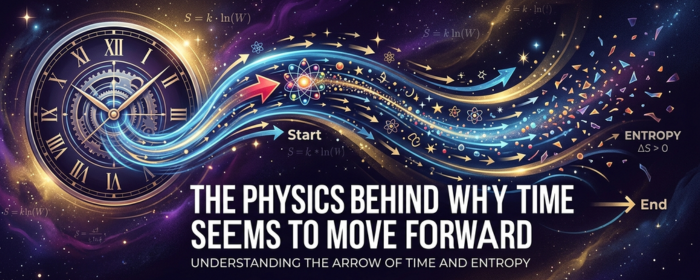
Why can you scramble an egg in seconds, yet no amount of stirring will ever put it back together? No, this isn’t about time travel or reversing the fundamental laws of the universe, but the answer to this simple question sits inside one of physics’ most elegant ideas: Entropy. In short, time appears to move in one direction because entropy, or the measure of disorder within a system, only ever increases in an isolated system, and this one-way drift towards chaos is what gives the universe its arrow of time. Sounds philosophical, right? But, on paper, this principle is more straightforward than you can ever imagine.
Students working through A-level physics tuition in Singapore often meet entropy as a dry equation on an exam paper, but it is really the reason that yesterday and tomorrow look nothing alike.
What is Entropy?
In the language of science, entropy measures how many different arrangements of a system’s particles would look identical from outside. For instance, a tidy room might have very few such arrangements, so it has low entropy; however, a messy room has millions, so its entropy is high.
Ice melting into water is pure entropy in action: the rigid, ordered lattice of ice molecules loosens into the far more disordered, freely moving molecules of liquid water. Isn’t physics beautiful?
Why Does Entropy Only Increase?
This is the second law of thermodynamics, and it is really a statement about probability, not force. Disordered states hugely outnumber ordered ones, so as particles bounce around randomly, a system is simply far more likely to drift towards disorder than away from it.
Hence, nothing forbids your coffee from spontaneously reheating itself; it is just staggeringly improbable.
How Does Entropy Explain the Arrow of Time?
Physicists call this the thermodynamic arrow of time, and it is one of several arrows that all seem to point the same way.
| Arrow of Time | What It Tracks | Everyday Example |
| Thermodynamic | Entropy increasing | Coffee cooling in a cup |
| Cosmological | The universe expanding | Galaxies drifting further apart |
| Psychological | Memory forming | Recalling yesterday, not tomorrow |
Could Time Ever Run Backward?
In theory, nothing in the equations forbids it. In practice, it never happens, because reversing entropy would require an event so statistically unlikely it may as well be impossible. According to a 2010 study published in The Astrophysical Journal, the entropy of the observable universe is estimated at roughly 3.1×10¹⁰⁴ (measured in units of Boltzmann’s constant), driven largely by supermassive black holes (Source). That number alone explains why the universe is nowhere near running in reverse, and why you should seek help from a JC physics tuition in Singapore while you still have time to solidify your foundation.
Conclusion:
Entropy and the second law appear right across the Singapore syllabus. Thus, if your child needs a firmer grip on thermodynamics or entropy in general, our O-level physics tuition in Singapore is the way to go!
Understanding entropy means understanding why the universe behaves as it does, and why second law questions catch out even confident students. At Best Physics TuitionTM, we turn abstract concepts like this into clear, exam-ready understanding.