Conservation Laws Every Physics Student Should Know
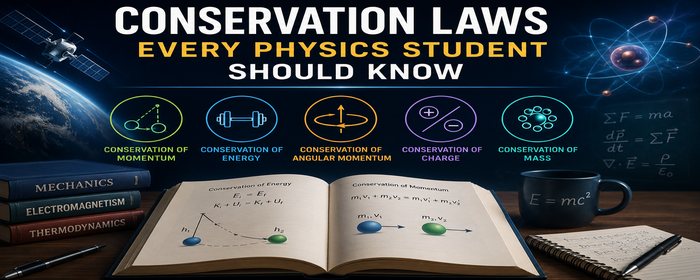
Have you ever solved a physics problem correctly, but at the end, you had no idea why the answer made sense? You might think that ultimately, I reached the right answer, so why should the route bother me, but not knowing why your answer is correct is also a reason why your physics scores are dipping below the horizon.
This usually happens when students mug up formulas without understanding the principles behind them, and one common area where this issue happens in physics is “Conservation laws,” or rules that remain true no matter how complicated a problem looks. Once you master these laws, you will stop seeing physics as a collection of equations and start seeing it as a connected system, but if you are having trouble with them, guidance from O-level physics tuition in Singapore and insights from this blog can be a real game-changer.
What Are Conservation Laws?
Conservation laws are the fundamental driving force behind physics which state that a particular physical quantity remains constant in an isolated system. While it may change or move from one object to another, the total amount stays the same. Fascinating, right?
These laws are greatly emphasised by the tutors at Singapore physics tuition because they form the backbone of mechanics and appear repeatedly in school as well as college-level exams. To help you grasp the basics of these laws, here’s a table on the subject matter:
| Conservation Laws | What Remains Constant? | Common Applications |
| Conservation of Energy | Total energy | Pendulums, roller coasters, free fall |
| Conservation of Momentum | Total momentum | Collisions, explosions, recoil |
| Conservation of Angular Momentum | Angular momemtum | Rotating bodies, skaters, planetary motion |
1. Conservation of Energy
The law of conservation of energy states that Energy cannot be created or destroyed; it can only change from one form to another. For instance, a falling ball converts gravitational potential energy into kinetic energy as it speeds up, and when you look around, you will find countless such examples.
When you understand the principle, it allows you to solve problems without tracking every force acting on an object, because instead, what you have to do is compare the total energy before and after the motion.
2. Conservation of Momentum
Starting from the very basics, momentum is defined as the product of mass and velocity, and the law of conservation of momentum states that: in an isolated system, the total momentum remains unchanged during collisions.
This law is important because it explains why a gun recoils after firing, why billiard balls transfer motion so efficiently, and how rockets move forward in space. Thus, whenever you encounter collisions, momentum should immediately come to your mind.
3. Conservation of Angular Momentum
Have you noticed how figure skaters spin faster when they pull their arms inward? Well, that’s the conservation of angular momentum in action.
As the skater reduces rotational radius, the rotational speed increases to keep the total angular momentum constant, and what’s more interesting is that the same principle explains the motion of planets, spinning tops, and even galaxies.
Learn the Principle, Not Just the Formula
Many students try to remember dozens of equations before an exam, but only successful students understand that most mechanics problems are built around just a few fundamental conservation principles. Once you identify which quantity stays constant, the solution often becomes surprisingly straightforward, and that’s where an IP physics tuition in Singapore can help you to make your basics rock-solid. Looking for tutors to solidify your fundamentals? Reach out to the team at Best Physics Tuition™ right away!