The 80/20 Rule for Scoring Better in Physics
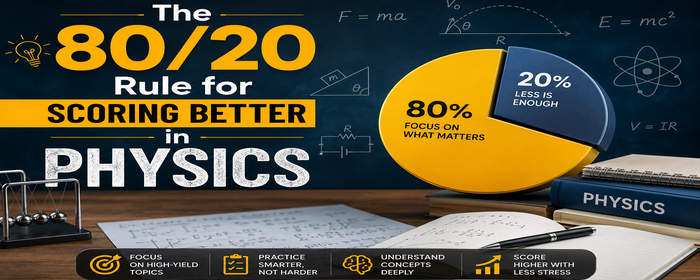
When students think about studying physics, they start by spending hours staring at complex equations, filling notebooks with derivations, yet their physics scores refuse to budge. It’s truly frustrating and exhausting, and at the end of the day, if you are a student, this makes you wonder if you aren’t just wired for the subject. But, what if we told you that the problem here isn’t your intelligence, it’s your strategy, and this is a point where the Pareto principle, commonly known as the 80/20 rule, can do wonders, along with aid from a professional tutor at O-level physics tuition in Singapore. Wondering what it is, and how it can help you score better in Physics? Well, here’s a blog to get started!
The Secret Physics Shortcut
The 80/20 rule suggests that about 80% of your results come from 20% of your efforts. Sounds bizarre, right? But, in the context of physics, this means that the vast majority of exam questions are drawn from a small, crucial core of fundamental concepts and chapter types, which means that instead of drowning in the entire textbook, your goal is to identify and master the vital 20%, and then move to the 80%.
Even when you conduct a historical analysis of competitive exams or core exam papers, you would see that they target core conceptual pillars like Mechanics and Electrodynamics. Thus, by shifting your focus to these high-yield zones, you can maximize your score while drastically reducing burnout.
High-Yield vs. Low-Yield Study
To ace your next exam, the first thing you need to do is categorise your syllabus. To further simplify things, here’s how a typical physics syllabus breaks down under the 80/20 lens:
| 20% High-Yield Core (Focus here First) | 80% Low-Yield Details (Review Later) |
| Mechanics, including Newton’s Laws, Conservation of Momentum, etc. | Niche derivations of complex formulas |
| Electrodynamics concepts like Gauss’s Law, Ohm’s Law, Circuits, etc. | Memorising obscure historical experiments |
| Modern Physics with topics like Photoelectric Effect, Bohr’s Model. | Low-weight introductory history chapters |
| Wave and Ray Optics with lens formulas wave interference basics, and more. | Complex, multi-step geometric proofs |
Note: To apply the 80/20 rule, analyze the past papers, mark the topics that appear every single year, or simply seek expert help from JC physics tuition in Singapore. Also, remember that Physics examiners love to tweak numbers, so if you understand the core concept behind any equation, you can solve any variation.
Conclusion
When we ask you to follow the 80/20 rule, that doesn’t mean you would leave the 80% chapters altogether. Just finish the chapters carrying the most weightage, and then you can move to the rest of the chapters to take weeks of guesswork and trial-and-error out of your exam prep.
Need help understanding how to implement the 80/20 rule? Don’t waste another hour drowning in low-yield textbook pages. Apply the Pareto Principle with expert guidance from Singapore Physics Tuition and transform the way you study.
Need more information or want help with Physics exam prep? Reach out to the team at Best Physics Tuition ™ today!