Common Mistakes that Students Make in Current Electricity Problems
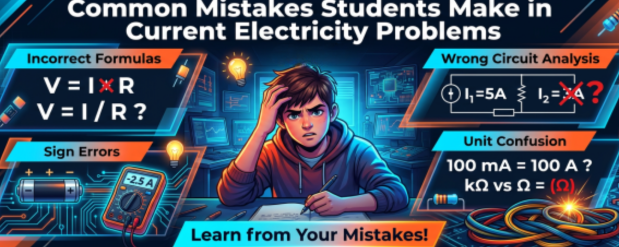
We have all been there when a multi-loop circuit problem took almost 20 minutes. You try to solve it by diligently writing down Kirchhoff’s laws and calculating fraction after fraction. You box your final answer with complete confidence at the end, just to flip to the back of the book and realise that your current is off by a negative sign, or worse, an entire order of magnitude.
Students commonly make mistakes in current electricity problems because they misapply formulas, confuse circuit concepts, and overlook calculation steps. Wondering why this happens so frequently? Well, let’s break down the most common pitfalls with tips from the tutors at an O-level physics tuition in Singapore, so you can avoid them on your next exam.
Are You Misidentifying Series and Parallel Resistors?
The single biggest trap in circuit analysis is assuming two components are in series, just because they sit side-by-side on paper. A series connection requires a single continuous path where current cannot split, and if a junction exists between two resistors, they are NOT in pure series. Similarly, parallel components must share the exact same terminal nodes.
The Rule: Always trace the path of electric charge with your pencil, and if you see the line splitting, you are entering a parallel branch.
Are You Messing Up Kirchhoff’s Loop Rule Signs?
Kirchoff’s Voltage Law (KVL) is conceptually simple: the sum of potential changes around any closed loop is zero, yet sign errors tend to run rampant. When you are traversing a loop:
- A potential drop moves across a resistor in the direction of assumed current (-IR).
- A potential rise (+IR) moves against a current.
- Regardless of current direction, a potential rise crosses a battery from negative to positive.
When you mix up these directional conventions, even the simplest system of linear equations can turn into a mathematical mess. However, if your doubts continue in this topic, it’s best to learn from a tutor at JC physics tuition in Singapore.
Do You Confuse EMF with Terminal Voltage?
An ideal battery provides a constant potential difference, but real-world batteries have internal resistance, and terminal voltage equals electromotive force only when no current flows.
When a battery discharges, the Terminal Voltage is calculated as the difference between the electromotive force and the product of the current flowing through the circuit and the resistance. When you forget to account for the resistance here, it can cause widespread calculation errors across internal resistance and power distribution problems.
To further clear things up, here’s a table to act as your quick reference on the core circuit concepts:
| Concept | Key Condition | Common Student Misconception |
| Series Circuit | Current is identical through all components | Believing voltage remains equal across different resistors |
| Parallel Circuit | Voltage drop is identical across all branches | Assuming total current passes through each branch |
| Internal resistance | Reduces output voltage under load | Treating terminal voltage as fixed and equal to battery EMF. |
Conclusion
Believe us when we say this: cracking current electricity isn’t about mugging up fifty variations of Ohm’s law; it’s rather about mastering core visual and analytical strategies. All set to master the concepts of physics with confidence? Reach out to our team at Best Physics Tuition™ today! Whether you are preparing for board exams or competitive entrance tests, our expert tutors at A-level physics tuition in Singapore can guide you past these common traps.