What Are Waves? Breaking Down the Basics for Students
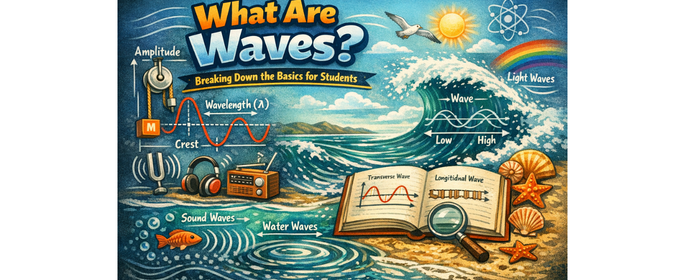
Have you ever felt like you are shouting into the void because your Wi-Fi dropped just as you were about to win that match on your video game console? Or maybe you have sat by the coast, watching the tide roll in, and you start wondering how a single splash on the other side of the world managed to travel all the way to your toes. The problem is, we are constantly surrounded by invisible forces that dictate how we see, hear, and communicate, yet most of us couldn’t explain how they actually move. That’s exactly what the world of “WAVES” explains. The tutors at our Physics tuition state that waves are the universe’s favourite way of getting things done without actually moving “stuff” from point A to point B, and today, we are going to break down the basics of this incredible concept for you!
The “Mexican Wave” Standpoint
To understand waves, you need to stop thinking about water for a second and think about a football stadium. When the crowd does a “Mexican Wave,” the people don’t actually leave their seats and run around the stadium; instead, they just stand up and sit down. The energy might move in a circle, but the matter (the fans) stays put.
In Physics, a wave is simply described as a disturbance that transfers energy through matter or space. Whether it’s light from a distant star or the sound of your favourite track, waves are the ultimate energy couriers.
Up, Down, and Side-to-Side
Every wave behaves in a different way, and we generally split them into two main personalities, including:
Transverse Waves:
You can think of transverse waves like a skipping rope. The energy moves forward, but the rope moves up and down. For the transverse waves, light and radio waves are classic examples.
Longitudinal Waves:
You can think of longitudinal waves as a slinky being pushed and pulled. The vibrations happen in the same direction as the wave travels, and one profound example of this is sound.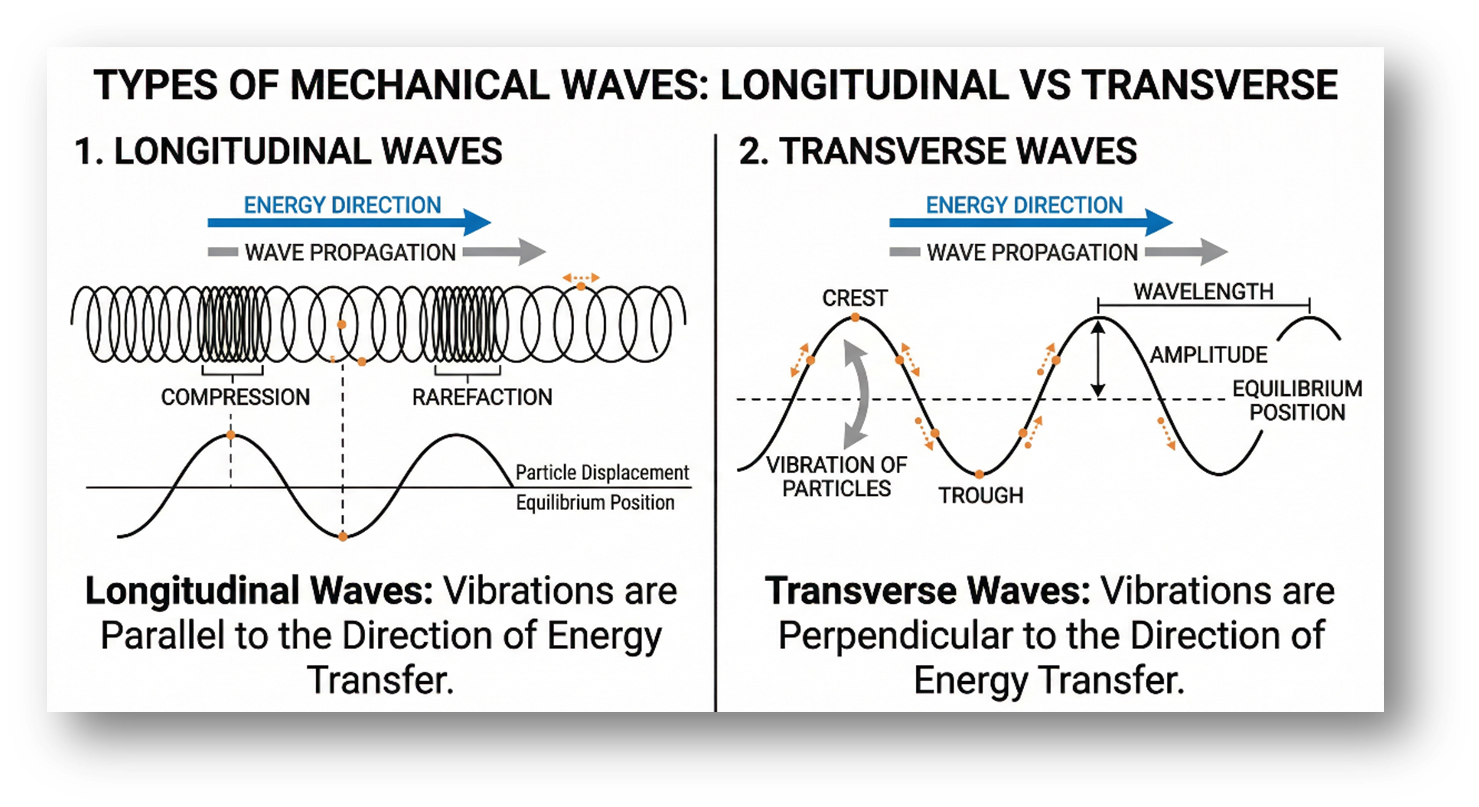
Although if you are struggling to visualise these differences for your exams, studying with H2 physics tuition in Singapore can offer specialised coaching to make these abstract ideas feel like common sense.
The Anatomy of a Wave
Every wave has a “signature” that is made up of four key parts:
Wavelength:
This is the distance from one peak to the next.
Frequency:
How many waves pass a point every second (measured in Hertz).
Amplitude:
This is the height of the wave (How “strong” or “loud” it is).
Speed:
How fast the energy is booking it across the room.
Did you know that the fastest thing in the known universe is a wave? Light travels at approximately 299,792,458 metres per second in a vacuum. That is fast enough to circle the Earth seven times in a single second! (Source)
Conclusion
Waves aren’t just for textbooks; they exist everywhere in the real world. In fact, they are the reason you can see this screen (light waves), hear my “voice” in your head (sound waves), and heat up your leftovers (microwaves). Understanding them is like learning the secret code of the universe. Once you see the patterns, the world starts to look a lot more connected.
Looking for sec-3 physics tuition to solidify your basics in Physics and understand concepts like waves, mechanics, and more in a comprehensive way? Reach out to our team at Best Physics TuitionTM today!