How Do Students Identify the Correct Direction of Different Forces?
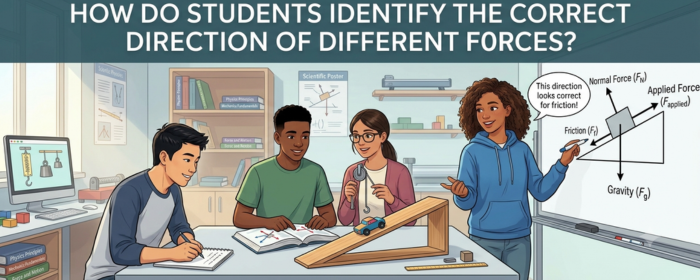
As a student, you might have solved a tricky incline problem, with the magnitude of every force being spot on, but still you might have lost three marks because one tiny arrow points the wrong way. Frustrating, isn’t it? The truth is, most Physics marks aren’t lost on numericals, but on direction. However, how do students identify the correct direction of forces? The answer is by asking what each force is relating to, rather than guessing things from habit.
This is exactly the kind of reasoning gap that a seasoned tutor in Singapore physics tuition is built to close, well before the problem shows up on an exam paper, and we are going to discuss all about it!
What Is Normal Force, and Why Does Its Direction Confuse Students?
Normal force always acts perpendicular to the surface of contact, while pushing away from it (never along the surface). Thus, a book resting on a flat table feels a normal force pointing straight up. But when you put that same book on a ramp, the normal force tilts with the ramp, perpendicular to the slope, not vertically upwards.
Hence, students who memorise, “normal force goes up” rather than understanding the fact that normal force goes perpendicular to the surface fall apart at the very moment when a question introduces an incline.
Which Way Does Friction Actually Point?
Friction opposes relative motion, or the tendency of motion, between two surfaces; it never has a direction of its own. For example, take a crate being pushed up a ramp: friction acts down the slope, resisting the push. If the crate slides back down instead, friction flips direction and acts up the slope.
The trick here is to first decide which way the object is moving or trying to move, then draw friction opposing that, and if you have trouble visualising things, a little help from IP physics tuition in Singapore can go a long way.
How Do You Get the Direction of Tension Right Every Time?
Tension always pulls along the length of a string or rope, away from the object and towards the point of attachment; it can never push. In a pulley system with two hanging masses, each string pulls its mass upward, towards the pulley, while gravity pulls it down. This single rule, tension pulls, sorts out most string and pulley confusion instantly.
To clear things up, here’s a quick table to remember the direction of all three forces:
| Force | Direction Rule | Common Student Error |
| Normal force | Perpendicular to the contact surface | Assuming it always points straight up |
| Friction | Opposes relative motion or its tendency | Drawing it in the direction of applied force |
| Tension | Pulls along the string, towards attachment | Believing tension can push |
Need more information, or want a deeper look at how friction problems trip students up beyond the formula? Read Why Friction Problems Are Rarely About Friction Alone.
Conclusion
If you or someone you know keeps losing marks to force direction slips, our O level physics tuition in Singapore rebuilds this reasoning from the ground up. Ready to stop losing marks over misplaced arrows? Get in touch with our team at Best Physics Tuition™ today!