Why Friction Problems Are Rarely About Friction Alone
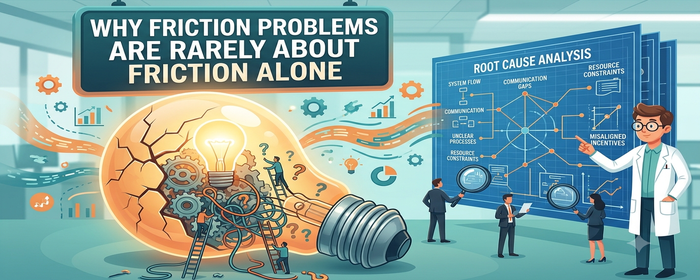
Before we talk about friction, let’s start with a classic physics textbook problem: a heavy wooden crate sitting stubbornly on a rough, inclined ramp. The question asks you to calculate the minimum force needed to push it upward, so you immediately reach for your go-to formula, Ff= µFn where Ff is the frictional force, µ is the coefficient of friction, and Fn is the normal force. However, as you start sketching the free-body diagram, things get messy.
You see that the angle of the ramp changes how hard the block presses into the surface; there’s an external rope pulling at an odd angle, which changes everything entirely, and suddenly, you realise that you aren’t just solving for friction. You are spinning multiple plates at once. That’s the great secret of mechanics: friction problems are rarely just about friction alone. Instead, friction acts like a mirror, while reflecting every other force, angle, and structural constraint acting on an object. Wondering how all of this works? Here’s a guide from the top tutors at Singapore Physics tuition to help you think of friction as a supporting actor, or the main character, depending on the scenario.
The Invisible Partner: The Normal Force
To understand why friction is so deeply intertwined with other forces, we have to take a look at its mathematical DNA. The frictional force directly depends on the normal force, i.e., the perpendicular push of a surface against an object. The catch here is that the normal force is like a chameleon, and it constantly shifts based on the environment.
For instance, if a heavy suitcase is sitting on a floor, and you try to push it off the horizon you fight a certain amount of friction. However, if a friend pulls upward on the suitcase handle while you push, the suitcase suddenly feels lighter, and sliding it becomes remarkably easy. Why? Because the upward tug reduces the load on the floor, which shrinks the normal force, which chokes out the friction.
In fact, there are several elements on which friction depends, and here’s a quick breakdown of it by the tutors at JC Physics Tuition in Singapore:
| Factor | How It Affects Friction | Example |
| Weight of object | More weight usually increases friction | Pushing a loaded cart is harder than an empty one |
| Surface type | Rough surfaces increase friction | Sandpaper creates more resistance than glass |
| Angle of incline | Changes normal force | Boxes slide differently on ramps |
| Applied force | Can determine whether motion begins | A small push may not move a crate |
| Motion state | Static and kinetic friction behave differently | Starting a bicycle is harder than keeping it moving |
Conclusion
Friction questions teach an important physics principle: never isolate a force from its surroundings. Physics is rarely about memorising equations. It is about understanding relationships. Friction depends on motion, force balance, gravity, and surface interactions. Solving these problems becomes much easier once you stop treating friction as the entire story. The next time you see a friction problem, pause before jumping to formulas. Ask: What else is happening here?
Ready to make physics concepts easier and more intuitive with O-level physics tuition in Singapore? Join Best Physics TuitionTM today and learn how to decode tricky topics with smart techniques, real-world examples, and expert guidance that makes physics finally click!