How to Use Retrieval Practice to Remember Physics Concepts for Longer?
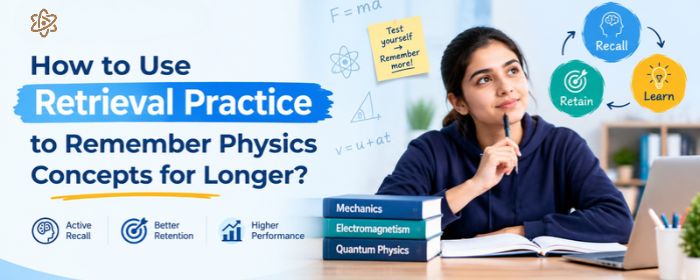
You read the chapter on Newton’s laws three times, highlighted half the page, and still went blank on the test. For those who are wondering why this is happening, and how you can dodge it, here’s the short answer: you can remember physics for longer by closing your notes, recalling the concept from scratch, and then checking what you missed. This method of recall is called retrieval practice. Cognitive science and years of classroom experience agree on one thing: in Physics tuition, students who test themselves beat students who only reread, and we are going to talk exactly about that!
Why Do Students Forget Physics That They Have Already Studied?
Most students end up confused and ask: why I cannot remember physics concepts after rereading chapters. But, the truth is rereading feels productive because the page looks familiar, but recognising a formula is a different skill from building a solution on a blank sheet, and exams reward only the second one.
The evidence here is striking because in a well-known 2006 experiment by Roediger and Karpicke, students who practised recalling a passage remembered about 61% of it a week later, while students who simply reread it remembered about 40%. They read the same material, same time, but retained very different things.
What Does Retrieval Practice Look Like in Physics?
It is simpler than it sounds:
The blank page dump:
Here, you close the book and write everything you know about circular motion or electric circuits, and then compare with your notes and circle the gaps.
The one-minute explanation:
Explain a concept aloud as if teaching a younger cousin, and if you stumble, you have found a weak spot.
The cold redo:
A week after solving a question, attempt it again, and see if you can do it without the worked solution.
How Can You Fit It Into Your Week?
You don’t need extra hours to fit things in; you need better timing along with aid from a professional physics tutor in Singapore:
When |
What to Do |
Time Needed |
| Same day | Blank page summary of today’s topic | 10 minutes |
| 2 to 3 days later | Redo two questions without notes | 20 minutes |
| 1 week later | Attempt a mixed set from different topics | 30 minutes |
| Before exams | Timed paper, then mark and fix gaps | 2 hours |
Why Should You Keep Going When It Feels Hard?
Remember that sinking feeling when you stare at a blank page? Or when you resort to the internet to ask questions like how to remember physics? It is not a sign that you are failing; rather, it is the memory that is being strengthened. Easy revision feels comfortable, but fades quickly, whereas effortful recall sticks.
This is why you need to pair this habit with treating every wrong answer as useful data, and your weak topics will shrink faster than you expect.
Conclusion
Self-testing works best when someone feeds you the right questions at the right difficulty. A good JC physics tuition in Singapore can help you move from foundational questions to challenging ones, and give feedback while the attempt is still fresh.
Ready to improve your retrieval capability and looking for H2 physics tuition in Singapore? Contact our team at Best Physics Tuition™ today!