Made a Physics Mistake? Here’s How to Learn From It
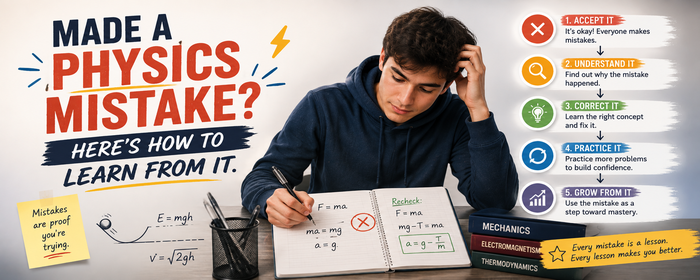
Every red mark on your Physics answer sheet is a tiny confession, a moment where your reasoning took a wrong turn, or where you made a mistake without knowing the facts. While most students see it as failure, only the best pupils see it as data. In fact, you can turn your physics mistakes into better problem-solving skills by treating your errors as a diagnostic tool: work out exactly where the logic broke, rebuild the correct method, and then test the fundamentals until they become instinct. That is the entire philosophy behind professional Physics tuition, and to explain things further, here’s a guide on the subject matter.
Why Students Keep Repeating Mistakes?
In Physics, most students repeat the same mistake because they fix the answer, not their thought process. If you lost marks for confusing mass and weight, simply writing the correct final value next to the wrong one teaches your brain nothing.
In fact, according to Edutopia, a study found that students who actively retrieved information before a high-stakes test remembered 60 percent of the material, compared with only 40 percent for those who simply reread their notes. Correction works the same way.
What Does a Good Error Actually Teach You?
In case you are questioning the significance of errors, let’s take a classic example:
A student calculates resultant force by adding vectors as if they were scalars. The wrong answer is not the real problem; the misunderstanding of vector direction is. Once a physics tutor in Singapore walks the student through why direction changes the arithmetic, that single mistake often fixes a dozen future questions on projectile motion, circular motion, and momentum, because they all share the same underlying logic.
To help you rise beyond your mistakes, here is a simple table to categorise your own errors before your next revision session:
| Mistake Type | What It Usually Means | Fix It By |
| Wrong formula used | Concept confusion | Re-derive the formula from first principles |
| Correct method, wrong answer | Careless arithmetic or unit slip | Slow, deliberate, re-working |
| Blank or guessed answer | Gap in understanding | Revisit the topic from scratch |
| Right answer, no working | Weak exam technique | Practise showing structured steps |
How Can You Build a Habit Around This?
Keep a single “mistakes notebook” for the term. Every time you lose marks, write the question, your original reasoning, and the corrected logic in your own words. Students preparing for H2 physics tuition Singapore examinations often find this single habit more valuable than another ten assessment papers, simply because it targets their actual weak points rather than practising what they already know.
Where Should You Go from Here?
If you want a structured way to convert errors into exam-ready skills, our JC Physics Tuition programme is built entirely around this diagnostic approach, with detailed post-lesson feedback on exactly where and why marks are lost. You can also browse for more such tips and interesting Physics topics on our blog.
Mistakes are not the enemy of good grades; ignoring them is. Ready to turn your next physics error into your next strong grade, or scouring the web with questions like how to improve marks in Physics? Contact our team at Best Physics Tuition™ today!