Right-Hand Rule to Lorentz Force: Problem-Solving Made Easy in Magnetism
In Physics, there is a fundamental difference between knowing a formula and understanding a force. You can memorize F = q(v x B) in seconds, but if you cannot visualise how a magnetic field physically deflects a moving charge, you will fail the most critical part of any magnetism problem: the direction. Whether you are analyzing a particle accelerator or a simple DC motor, the Lorentz Force is the invisible hand of electromagnetism that you cannot miss.
However, here, the challenge isn’t the math; it’s the spatial reasoning. Thus, if you find yourself guessing between “into the page” and “out of the page,” you won’t just miss a sign; you will be missing the mechanics of the universe. Want to master magnetism by moving beyond theory and diving into strategic application? Here is a guide from the tutors at our O-level physics tuition in Singapore to help you get started.
What is the Lorentz Force?
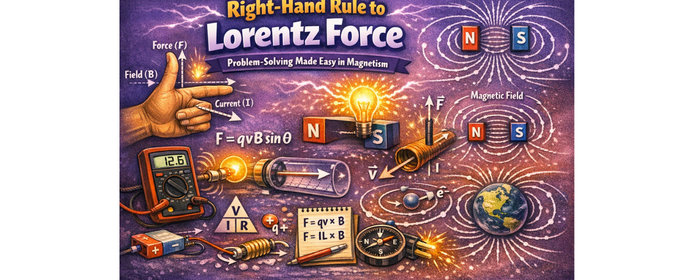
At its very epicenter, the Lorentz Force is the physical push that a magnetic field exerts on a moving charge. We would say it’s the reason that electric motors spin and the core principle on which old-school CRT televisions painted images on a screen. The formula for the Lorentz Force looks something like this:
F = q(v X B)
Here, the force (F) depends on the charge (q), how fast it’s moving (v), and the strength of the magnetic field (B). But, because these are vectors, the direction is everything, and this is where most students get tripped up.
Your Biological Compass: The Right-Hand Rule
To solve all these problems without breaking a sweat, you need to consider the Right-Hand Rule (RHR). You can think of your hand as a 3D coordinate system in this. To make this clear, here is the easiest way to map it out:
Thumb:
Points in the direction of the velocity (v) of a positive charge.
Fingers:
Point in the direction of the magnetic field lines (B), usually from North to South.
Palm:
The “push” coming out of the palm represents the direction of the force.
Pro Tip: If you are dealing with an electron (a negative charge), just use your left hand or flip the final result of your right hand. Did you know that the Earth’s magnetic field is actually quite weak? It measures only about 25 to 67 microteslas, which is roughly much weaker than a common refrigerator magnet! (Source)
Still having trouble remembering things or applying the Right Hand Rule, feel free to seek extra help from the tutors at an A-level physics tuition!
Making it Stick
The secret to “Easy Mode” in magnetism is consistency. Don’t just visualize it; actually move your hand during practice! Align your fingers with the field, point your thumb with the current, and see where your palm faces. Once this becomes muscle memory, those “impossible” 3D diagrams become as easy as pointing at a map.
Scouring the web and your neighborhood for professional physics tuition? Contact our team at Best Physics TuitionTM today and master the fundamentals of magnetism, optics, electricity, thermodynamics, waves, or other important concepts in Physics.