How Can Dimensional Analysis Catch Your Physics Mistakes in 30 Seconds?
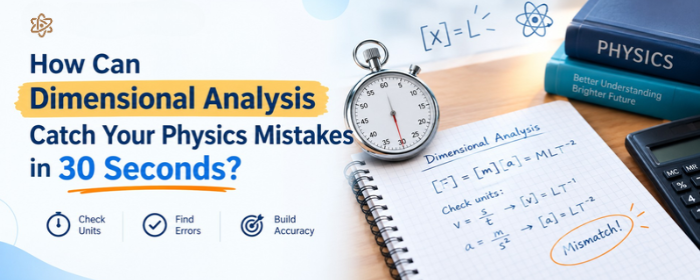
The way you worked your Physics problem says that a trolley accelerates at 12 metres per second, and the answer might also look fine at 11:00 p.m. However, it is wrong, because acceleration is measured in metres per second squared, and a 30-second habit would have caught it. Dimensional analysis checks that both sides of an equation are built from the same base units, so it exposes careless errors before the examiner does, and after years of watching students lose easy marks, the one piece of advice that every tutor at a renowned Physics tuition gives is that: treat units as a free marker hiding inside every question. Wondering how to do that? Well, here you go!
What Is Dimensional Analysis?
Every quantity in Physics is a recipe of base units, like kilogram, metre, second, ampere, and kelvin. Dimensional analysis rewrites each term using those ingredients and asks one question: do both sides match? If they don’t, then the equation is wrong, no matter what your calculator says.
How Do You Check an Equation?
Well, you can check any equation in three easy steps: swap each symbol for its base units, simplify each side, then compare.
For example, you can test s = ut + ½at².
The term ut becomes (m s⁻¹)(s) = m, and at² becomes (m s⁻²)(s²) = m.
Both are lengths, so the equation survives.
If this sounds insightful, you can keep this table handy for the usual suspects in dimensional analysis where most students lose marks:
| H3- Quantity | H3- Unit | H3- Base Units |
| Force | Newton (N) | kg m s⁻² |
| Pressure | Pascal (Pa) | kg m⁻¹ s⁻² |
| Energy | Joule (J) | kg m² s⁻² |
| Power | Watt (W) | kg m² s⁻³ |
Why Do Even NASA Engineers Need This Check?
In 1999, NASA lost the Mars Climate Orbiter, a $125 million spacecraft, after one team used English units while another used metric for a key operation. One unchecked unit ended an entire mission. If it can happen to rocket scientists, it can happen to anyone in the exam hall.
Note: Although dimensional analysis is immensely useful, most students also forget that it cannot see pure numbers, so a missing ½ in kinetic energy or a forgotten 2π passes silently. It does expose one sneaky trap, though: anything inside sin, ln, or an exponential must have no units at all.
How Do You Make It a Habit?
The key is to start early. Sec-3 is where base units first take centre stage, so start drills at this level to build a habit that lasts all the way to the finish line. At JC level, derivations and “show that” questions reward a homogeneity check, so whether you choose A level physics tuition or H2 physics tuition in Singapore, make sure units stay in your routine.
Two quick rules help massively here:
- First, write units on every line of working, not just the last.
- Second, pair the check with choosing the correct equation, which our guide on how to identify the right physics formula every time explains well.
Conclusion
For those who are still scouring the web for “how to stop making mistakes in dimensional analysis?” the right guidance from a tutor at Sec-3 physics tuition can go a long way! Ready to turn careless slips into secure marks? Reach out to our team at Best Physics Tuition™ today and solidify your concepts by learning from the best!