The Physics of Constraints: Why Objects Move Together
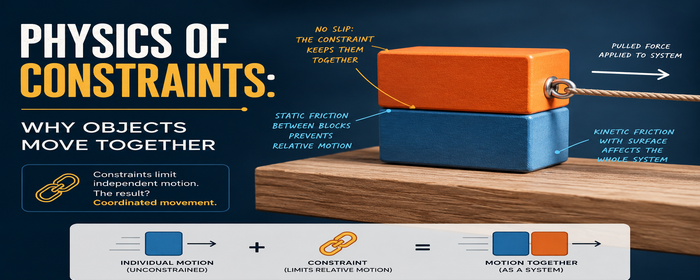
You push a box across the floor, and that’s easy enough, but when you tie two boxes together with a rope and push one, suddenly you see that both the boxes are moving. Or when you think about train compartments, elevators with pulleys, or two people carrying a couch upstairs, you would notice how objects behave like one system instead of separate pieces. Now, this may seem simple in real life, but in physics, this is where many students get stuck. We naturally think of objects individually, but nature often works differently.
In many real-world situations, objects are linked by constraints, or rules that force them to move together in specific ways. Understanding constraints with the aid of A-level physics tuition can help transform difficult mechanics problems into surprisingly manageable ones. Wondering how? Well, let’s unpack the physics behind it.
What Exactly Is a Constraint?
A constraint is simply a condition that limits how objects can move. When two objects are connected through a string, rod, pulley, track, or surface, their motions become dependent on each other. For example:
- Two blocks connected by a rope cannot move independently
- Train coaches coupled together accelerate as one unit, or
- A rider and bicycle often move together as one system under constrained motion
Constraints create relationships between positions, speeds, and accelerations, so instead of solving motion separately for every object, physics allows us to treat connected systems as linked.
Everyday Examples of Objects Moving Together
Physics is full of hidden constraints, and to help you understand that, here’s a table:
| Situation | Constraint | Result |
| Train compartments | Coupling links | Same acceleration |
| Elevator pulley system | Fixed rope length | Related motion |
| Tied boxes | Inextensible rope | Move together |
| Conveyor belt packages | Surface interaction | Shared movement |
| Two people carrying furniture | Rigid object connection | Coordinated motion |
Here, try to notice something interesting: the objects themselves are different, but the underlying principle remains the same, and in case you are having difficulties understanding the force, reaching out to H2 physics tuition in Singapore can be a great way to understand concepts beyond the classroom.
Why do students often find this difficult?
Students usually focus on forces first:
- “This block has tension.”
- “That block has gravity.”
But constraints are not forces; they are conditions, so the trick to solving problems here is realising that connected objects share motion relationships before writing equations. Once you identify:
- What is connected?
- What cannot stretch, bend, or separate?
- How movement of one affect another?
The problem becomes far easier, and many complex mechanics questions suddenly reduce to a few simple relationships. However, if you still cannot identify these elements, seek out aid from a tutor at Sec 3 Physics Tuition today!
Conclusion
Physics is rarely about isolated objects, because often it is about interactions. Constraints reveal a deeper truth i.e. motion often happens collectively. Thus, once you stop viewing objects separately and start seeing the connections, mechanics start to feel less like memorisation and more like solving a puzzle.
Ready to master Physics with Physics tuition? Contact our team at Best Physics TuitionTM today and learn complex ideas like constraints, mechanics, and motion through intuitive explanations and real-world examples.