Understanding Heat Transfer Through Real-Life Examples
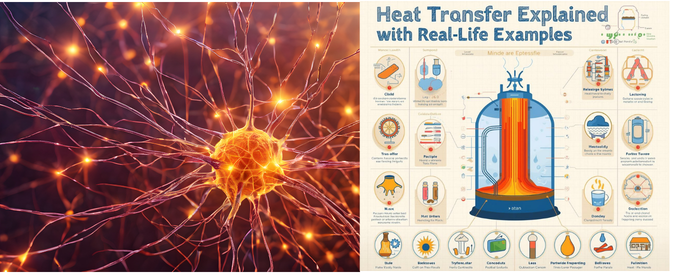
When you touch a metal spoon left in hot soup, why does it burn your fingers? Why does a thick woollen blanket keep you warm when wool itself is not hot? And if heat always moves from hot to cold, why does a fan feel cooling when the air it blows is the same temperature as the room? These questions point to three very different mechanisms. Conduction, convection, and radiation each behave completely differently. Once you see each one through a real example, the topics stop seeming so difficult, and an O-level physics tuition in Singapore simplifies the process with day-to-day examples that you can actually relate to. Here are a few to get you started.
Understanding Conduction With Metals
Pick up a metal ruler sitting on a cool day and it will feel cold to the touch. Pick up a plastic ruler right beside it which feels warmer. Both are exactly the same room temperature but the difference is in how quickly each material conducts thermal energy away from your skin. Metal is a very good conductor so it transfers heat rapidly from your hand, and your brain reads that rapid loss as coldness.
Plastic is a poor conductor so it transfers heat away slowly, as a result your hand barely notices. This is conduction: thermal energy transferred through direct particle-to-particle contact through a material.
Convection When the Fluid Does the Work
Fill a pot with cold water, place it on a stove and add a couple drops of food colour. Watch carefully once it starts heating as the water closest to the flame heats up first. As it heats, it expands slightly and becomes less dense. Less dense water rises and cooler, denser water at the top sinks to take its place. That cooler water then heats up, rises, and the cycle continues.
This circular movement of fluid is a convection current, and it is responsible for distributing heat throughout the entire pot and the same process drives sea breezes over Singapore, and JC physics tuition in Singapore use examples like this to explain topics that may sound tough theoretically but become much easier when understood with the help of an example.
Putting It All Together
The thermos flask actively fights every method of heat transfer. The double-walled glass construction creates a vacuum between the two walls preventing both conduction and convection, because both require a medium. The silvered inner surfaces tackle radiation. Now you know how these concepts actually make our life easier. Here is a quick reference that connects each mechanism to its real-world example:
| Mechanism | Requires | Everyday Example |
| Conduction | Physical contact through a solid | Metal spoon heating in hot soup |
| Convection | Movement of a fluid (liquid or gas) | Boiling water circulating in a pot |
| Radiation | No medium required | Sunlight warming Earth across space |
Conclusion
Whether you are building your secondary school foundation or sharpening exam technique through Singapore physics tuition at the A Level, concept-first teaching makes the real difference. Visit Best Physics Tuition ™ and see how Physics starts making sense when taught properly.